The Evocation of Sitri: Between Materials, Obstacles, and the Theater of Illusion
September 2, 2026 at 6:47 pm,
No comments
This is the first part of my report on the recent evocation of Sitri during the eclipse. I detailed the process of tearing the spirit's presence out by force, from the initial blockages to the heavy atmosphere in the triangle of art. I also shared a piece of our dialogue that reveals the deceptive nature of his performance.
The evocation of Sitri, which I had been preparing for so long, is finally complete. I would like to thank everyone who participated and stood by me; your involvement gave me strength in this struggle. The time has come to summarize this work, draw a proper conclusion, and understand how authentic this experience truly was, as well as how it can be useful to us in the future.
I might be starting from the end, but materials matter—the precision and thoroughness of the preparation constitute the greater part of both the result and the process itself. You have probably seen the video where I crafted a pentacle from deer skin (since Sitri belongs to the sphere of Jupiter, and the deer is an animal associated with Jupiter). Here is what this pentacle looked like after the evocation.
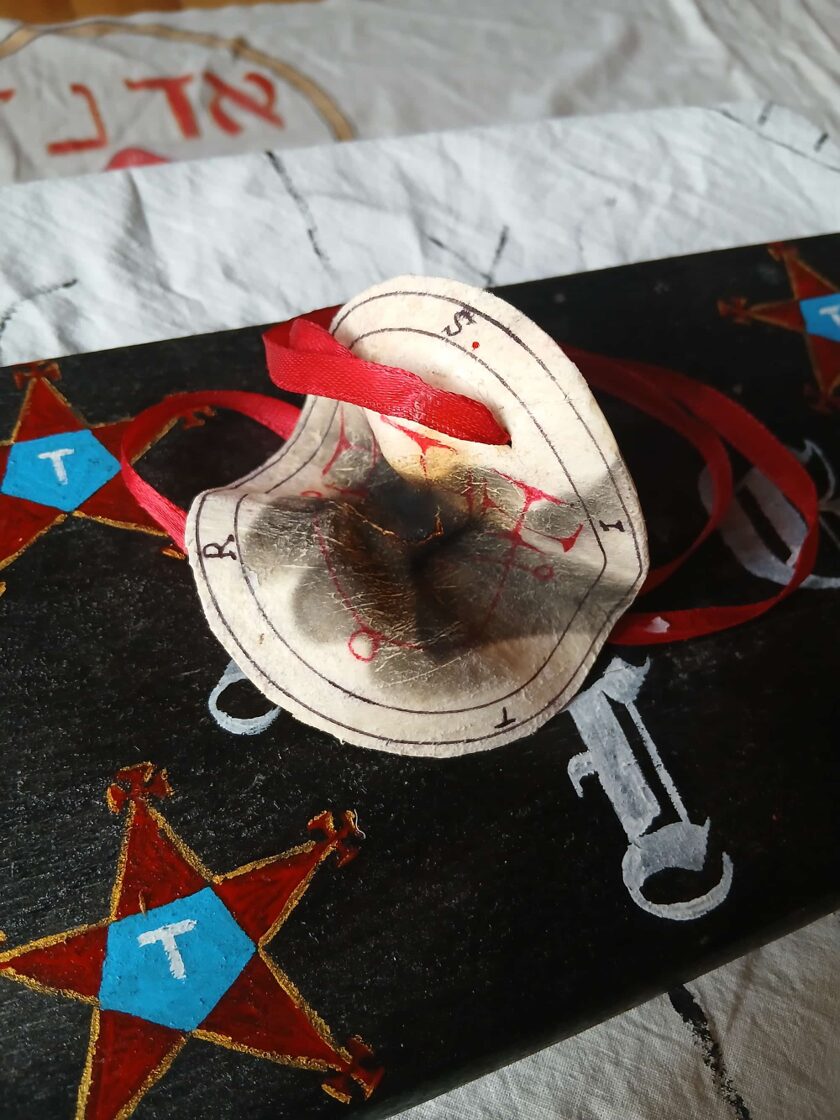
Why did it turn out this way? In almost all versions of the Key of Solomon or Faust's grimoire tradition, you will find methods of "scourging and punishing spirits that resist appearing." The methods vary: while the Faustian lineage most frequently involves striking the sigil with a specially prepared rod inscribed with "Death, where is thy victory? Hell, where is thy sting?", the Key of Solomon usually features the burning of the sigil over consecrated fire, sometimes inside an iron box with sulfur and other substances (as for what that box actually represents, a separate post should be written, since this topic is hardly ever uncovered anywhere).
Why am I writing about this now? Because it was one of those difficult, prolonged evocations where the spirit not only refuses to appear, but it feels as though existence itself is actively resisting the meeting. It had to be torn out by force, and it was truly long and difficult. The fact that the sigil was not merely drawn on paper but crafted on leather allowed me to gradually burn it over a candle (as I still have not made the iron box for roasting) for no less than two hours before he was finally compelled to appear (you can imagine the smell). A paper lamen would have simply burned up here, resulting in a complete fiasco.
But let us return to the beginning of this story, to the day before the evocation itself, August 27, 2026. Everything had been ready for a long time: the circle was laid out, every instrument was in its place, and all the candles, water, salt, etc., were consecrated, prepared, and positioned. The time had come for the introductory evocation, the final consecrations of the temple, and the ritual to close the sacred space against all "superfluous" forces.
And that was when the real obstacles began. I felt as though all my enthusiasm, zeal, strength, energy—or any other term that fits this list—had suddenly left me, which is quite uncharacteristic for me. I understand this sounds foolishly trivial, even childishly immature, but it was something else; I felt like a phone with only one percent of battery left. Nonetheless, I set to work, and after the basic Conjuration of the Four and the Conjuration of the Seven, I entered my working rhythm and managed to overcome this strange state.
The next day, the day of the eclipse which occurred at 6 a.m. my local time, I began my work early in the morning. By 6 a.m., I had already performed the first opening ceremony along with the Hexagram Ritual (the exact Golden Dawn practice I wrote about in the article on the Hexagram Ritual and why I need two wands for it). Following that, throughout the day, I performed several additional preparatory actions, such as the final consecrations of the signs and names of the participants, among other things.
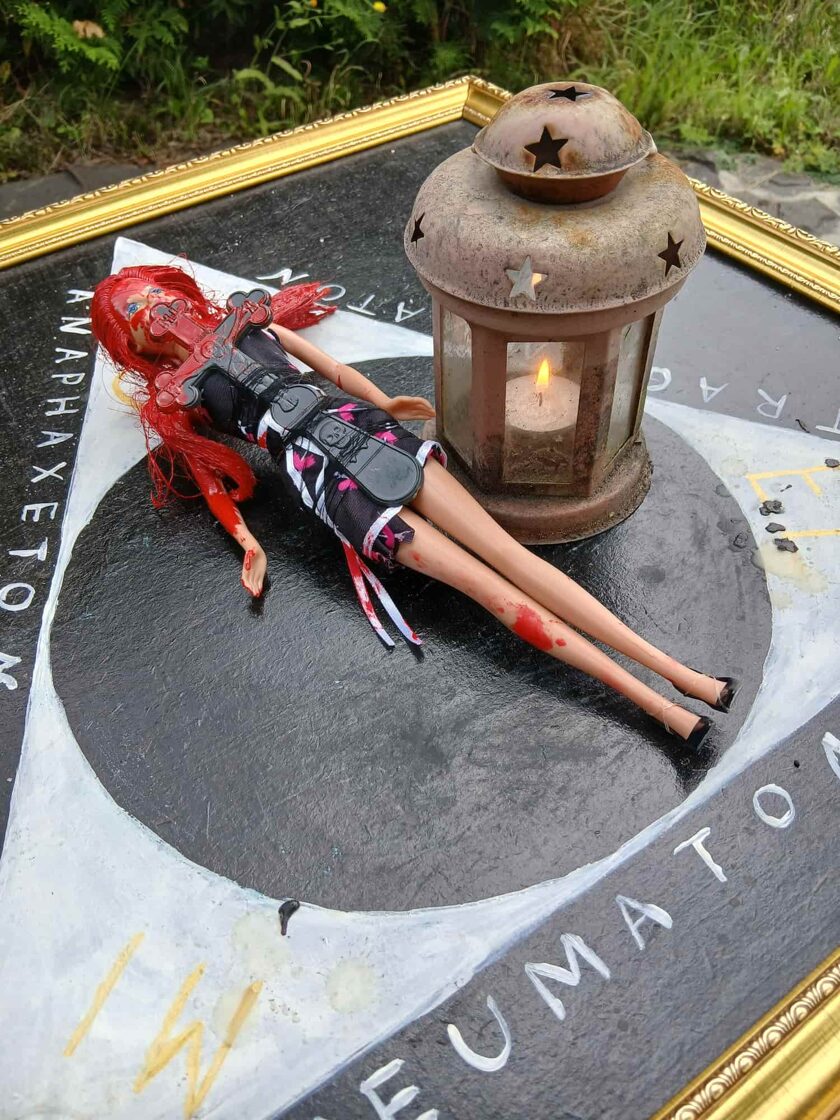
And then, the moment arrived. At 1:20 a.m., I began the evocation. I started by opening the spirit's vessel, which was a doll—the preparation of which I hope you saw on my Instagram. I cut away the cross with which it had been sealed, and I stepped into the circle.
The sensation of a presence appeared quickly enough, but it refused to manifest into an actual "presence." It felt like trying to pull a cat from under a couch—a cat that has absolutely no desire to come out. I recited the entire set of conjurations, which took at least an hour, but it changed very little. There was a feeling of an all-encompassing, total drag on all my efforts. That was when I proceeded to the previously described roasting of the pentacle.
And that shifted the situation. While the conjurations did create a lasso, a chain leading to the spirit, the roasting process actually inflicted pain upon it; I could literally feel it. During the roasting, I took turns reading prayers and conjurations until I felt the arrival of the spirit. I cannot say that it was highly visual or that I saw him the way I see myself in a mirror; no, it was rather a total, all-consuming sense of presence, and the epicenter of that dense, heavy, pressing presence was within the triangle of art.
In describing the images I saw, I ought to explain what it actually means to SEE A SPIRIT. After all, a spirit has no physical body, physical light does not interact with it in any way, and it possesses no vocal cords, so it cannot speak. This is actually a very important topic, and I will certainly write about it in a future article, but for now, let us limit ourselves to the description of this invocation.
Initially, I saw images of something resembling a lynx or a leopard (although the Lemegeton specifies a leopard), but later, once the spirit was fully bound, the imagery shifted to theatrical curtains. It resembled the backstage of an opera, and from behind the curtains, a hand and a head appeared—more female than male. It seemed displeased at being disturbed, as if something very important and interesting was happening there backstage, and I was pulling it away and interfering. However, I later realized that both the figure and the curtains were entirely him—one large and indivisible Sitri, who is this entire theater.
Next, I will present a portion of our dialogue:
- When I compel people to strip bare, I simply withdraw myself from them and reveal myself beneath myself. I push myself aside to show myself.
- Why do you mock them?
- I mock those who believe in my performance.
At this point, I understood what he meant by "believing in my performance." Sitri’s performance is 20-year-old girls on a yacht with 65-year-old men. Woe to the old man who believes in that girl's love; he will certainly be laughed at. But as for those men themselves, isn't it laughable for them to watch these girls "play the performance of love"?
I am, of course, hyperbolizing for clarity, but how many times have I seen a person sincerely believe in love when they are next to an ordinary prostitute acting for benefits. I have seen men like this too, playing a part because the girl's father is the minister of energy. All these situations are created from Sitri; they are his flesh and blood. In this context, he is both the stage and all the actors upon it.
But what is meant by "withdrawing myself from myself to show myself"? Stripping down usually means revealing authenticity, what lies behind the mask and backstage. But not in this case. Here, stripping does not remove the mask, and consequently, it does not form true intimacy. In Sitri's domain, stripping is merely a commodity, a means, a tool. Undressing a true lioness, you might find a gentle kitten beneath her clothes; but undressing a prostitute, you will find only a prostitute beneath hers.
This was the first part of the story. In the next one, I will try to describe everything that fell outside these boundaries: what the presence of a spirit is, how communication occurs with an entity that has no physical body yet is no less real than matter, and why I dedicated so much attention not only to establishing contact with the spirit (creating the vessel in the form of a doll) but also to building its exit paths (the ritual of burning the doll and burying the sigil with the cross).